Showing posts with label Bible圣经. Show all posts

Friday, April 4, 2025

NEW! NEW! Sunday Gospel Channel on You-Tube

Our SUNDAY GOSPEL CHANNEL is now officially launched.

Exciting News.  By the grace of God, we are launching a Sunday Gospel Channel on you-tube to proclaim the Name of Yahweh and to preach the Gospel by directing people to the one God Yahweh and Jesus Christ the Messiah.  Remember us in prayer that the Name of God be glorified and that you will also join us to share this channel with your friends, families, and colleagues.  Let us join hands together to make God's Name known to the world that they can come to have salvation through His Son, the Messiah Jesus. 


< Sunday Gospel频道 >  现已正式开通。

这是令人兴奋的消息。 承蒙神的恩典,我们在 YouTube 上推出周日福音频道(Sunday Gospel Channel),宣扬雅伟的名字,并引导人们信奉唯一的神雅伟和他所膏立的弥赛亚耶稣基督,从而传播福音。 请在祷告中记念我们的事工,愿神之名得着荣耀,愿您也能关注我们,与您的朋友、家人和同事分享这个频道。 让我们一起携手让世界知道神的名字,使他们可以透过神的儿子弥赛亚耶稣领受救恩。

👥


Monday, October 17, 2022

01 圣经书卷单词搜索 - 何西亚书 Bible Books Word Search - Hosea - Excel Spreadsheet for Download

In this new series of Bible Book Word Search, I would like to help all our readers to search out all words of each book of the Bible, so that we can study the Word of God with clarity and accuracy.

One of the first things we need to do is to search out all the words that occur in the book.

In the coming days, we will systematically search out all the words that occur in each Book of the Bible.


The Method:

1.  All the data will be collected from the YahwehDeHua Website
2.  The final format will be put in an Excel format
3.  An Excel document will be provided for our readers to download at the end of each blog
4.  From there, you can start doing in-depth word studies to find the keywords and key themes of the Book.


Twelve Minor Prophet Books

We will begin with the 12 minor prophet books in the following order:

1. Hosea 
2. Joel 
3. Amos 
4. Obadiah 
5. Jonah 
6. Micah 
7. Nahum 
8. Habakkuk 
9. Zephaniah 
10. Haggai 
11. Zechariah 
12. Malachi 


BOOK OF HOSEA


To do word studies of each book:

Part A:  Collect individual words from the book

Part B Collect word families of the book    (Some individual words are grouped together in family groups)


Part A:  Individual Words of the Book of Hosea

Collect Data from YahwehDeHua Website

Step 1:    Go to: http://yahwehdehua.net/cn/snstats/ot

Step 2:    Choose the book:  Hosea


Hosea has 14 chapters:  From Hosea 1:1 to Hosea 14:9


Step 3:    Scroll to the bottom of the page:


Hosea


1.  Hit "All Hebrew Numbers"

2.  Hit "Submit an enquiry"


Step 4:    The data will appear on this page

Hosea


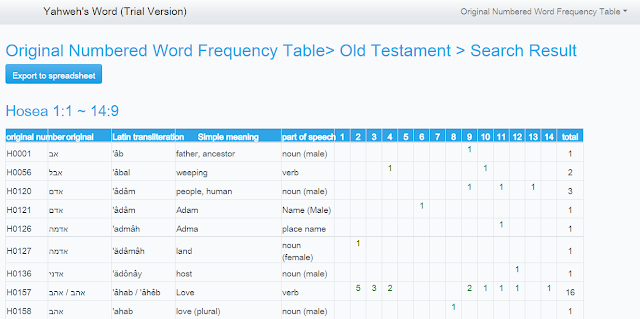
This page is very long, so I show you only part of the page from the top.

1.  All the words are listed in the order of Strong's Numbers of Hebrew words

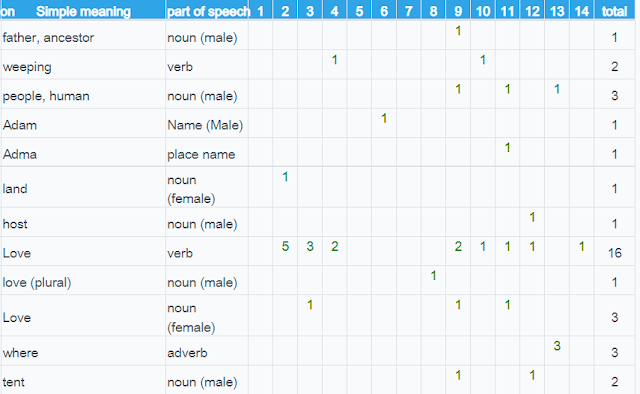
2.  If you look closely at the data even in these few words, you can see that the word "love" which is a theme of Hosea occurs 16 times.


Hosea


The table also shows you how the word "love" is spread through the 14 chapters of Hosea.
- the most occurrence of "love" is 5 times in Hosea Chapter 1.
- or we can group them together that "love" occurs from Hosea 1-3 and Hosea 9-13
etc.

This gives you an idea of where the keywords are located and in which chapter or sections inside the book.


Step 5:  Export to Spreasheet

Hosea


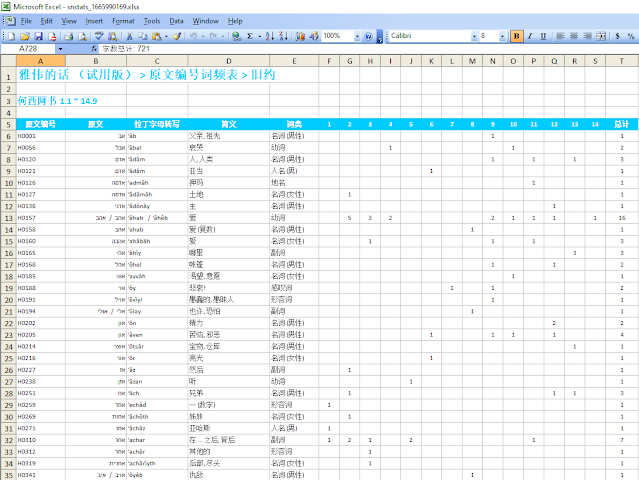
Click to "Export the spreadsheet": Excel format:

Voila!


Hosea


I will attach the Excel Spreadsheet for you to download onto your computer.


Once you have the Excel spreadsheet, you can do anything you want to find the information you want in terms of word frequencies, word occurrences of each chapter, the spread of the word in the book, the theme of each chapter, and the theme of the book.

Of course, word studies is only a start in exegesis. Context is most important when it comes to looking for themes in the book. You need to find not only individual words but how the words are used in the context of the chapter, the section, and the entire book.

Learn to look for "Key Phrases".  The Key phrases will direct you to the theme of the Book.  For Key phrases, you need to read the entire book at one sitting to grasp the whole context.  What I do is that in the next 14 days, I read the entire book once each day in prayer to absorb the message that God wants to speak to me.


Here are the 50 most frequent words of Hosea:


The larger the word, the higher the frequency:

- YHWH   -  46X
- Israel      -  44X
- Ephraim  - 37X
- God         - 26X

Looking at the words will give you an idea of some of the themes in the book.


Of all the prophets in the OT, Hosea pays special attention to Ephraim:


Hope you have enjoyed today's blog.

Feel free to give me your feedback,
Rosa

PS  I will do Part B in the next post and take you step by step!


-----------------------------

01 圣经书卷单词搜索 - 何西亚书 - Excel电子表格下载


一新的圣经书单词搜索系列中,我想帮助者借着搜索出圣每一本的每个单词,好清晰准确地考神的话语 

在接下来的日子里我会系统地在每本圣经书搜索所有出现的单词


The Method 方法:

1.       所有数据均来自雅伟的话语网站YahwehDeHua Website

2.      最终将以Excel 格式呈现

3.      每篇博文的末尾都会提供Excel文档供读者下载

4.      Excel那里您可以开始筛选进行深入的单词查考以找到该书的关键词和关键主题


十二卷小先知书


我会以下的顺序从12卷小先知书开始:


1. 何西亚书

2.

3. 阿摩西书

4. 俄巴底亚书

5.

6. 弥迦

7. 鸿书

8. 哈巴谷书

9. 西番雅书

10. 该书

11. 撒迦利亚书

12. 玛拉基书


何西亚书


 每一书卷进行单词查考:

 A 部分从书中搜集单词 (single words)

 B 部分搜集书中的字系  (word family) ( 有些单词是合在一系)


A部分何西亚书的单词

从 YahwehDeHua 网站收集数据

 第一步: 《》网站 http://yahwehdehua.net/cn/snstats/ot

 第二步选书卷何西亚书


何西亚书一共有14:从 何西亚书1:1  到  何西亚书14:9


 第三步滑到页面的底部:


1.  

 1. 点击希伯来文全部

    2.  "提交查询"


第四步数据会显示在这页面


这个页面很长我只是给您展示了页面的顶端部分 

 1.  所有单词是以《史特朗经文彙编希伯来语原文编号顺序列出

 2.  你仔细观察这几个词的数据你会发现作为何西阿其中之一主题关键词:这个词在这里出现了 16


該表还向您展示这个字是如何分布在何西亚书的14章书里的

  • 的出现次数最多是在何西亚书第一章一共5
  • 或者,我们可以将它们归纳一下这个字出现在何西亚书的1-3章和9-13 

等等


这样就让您可以了解关键词的位置以及在书中哪些章节曾出现过


第五步导出电子表格


点击汇出至试算表” :输出excel 格式


我将附上Excel电子表供您下载到您的电脑上


 ==> 您只需在此点击下载何西亚书单词Excel电子表!!

好好享用!!


一旦您有了这Excel电子表格您就可以随意地做许多事情来分析您想要的关于单词的信息包括出现的字频率在书中每章节的出现与分布情况每章书的主题关键词和全书的主题关键词


当然字意查考仅仅是释经的开端要找到书的主题上下文的联系是最重要的您不仅要找出单个单词您还要找出这些单词在章节段落乃至整本书的上下文中如何使用


学习找出关键短语(Key Phrases)关键短语将会引导您书的主题而这关键短语需要您一口气读完整本书以致掌握全书的上下关联我会在接下来的14天里 每天都在灵修时间中读整本书一遍以吸收神想对我说的信息


这是何西亚书中50个最常见单词


字体越大的单词就是越常见的单词


- YHWH   -  46X

- Israel      -  44X

- Ephraim  - 37X

- God         - 26X


留意这些单词会让您对书中的一些主题有所了解


在旧约所有的先知中何西亚特别关注以法莲


希望您喜欢我今天的博文


欢迎您给我回馈哦!!


另外我会在下篇文章中写 B部分带您一步一步来


Thursday, September 22, 2022

TheWord 圣经注释模块 TheWord Commentaries Modules

今天我们来到TheWord 圣经注释部分。

同样,它有一个付费部分和一个免费部分。


付费部分长,有更多最近的作品。

这是工具的简短列表:

  • IVP  Bible Background Commentary 圣经背景注释,新约 (IVPNT) USD $25.95
  • IVP Bible Background Commentary 圣经背景注释,旧约 (IVPOT) 美元 $19.95
  • New International Commentary 全套新国际解说:NICOT & NICNT,总价1095.68美元.  哇!

对于免费注释:

  • Jamieson, Fausset 和 Brown 于 1871 年的  Commentary Critical and Explanatory on the Whole Bible (JFB) 对整本圣经进行评论和解释。
  • Matthew Henry's Concise Commentary on the Whole Bible 整本圣经的简明注释(MHCC
  • Word Pictures in the New Testament 新约希腊文解经(词字解说)(RWP
  • Word Studies in the New Testament 新约词汇研究(VWS


谨慎地说,当我们使用注释时,请小心留意:注释都是从作者的角度出发的。

我们每个人都有从学习、经验和背景所塑造出来的神学理解。

除了圣经之外,没有绝对的方案可以衡量它的正确与否。因此,注释不应该作为快速的答案来源,而是作为放大镜让你查考圣经的含义。

Tuesday, September 20, 2022

查经工具:TheWord > 免费词典 Tool for Bible Studying: TheWord > Free Dictionaries

 TheWord 應用程序有 2 個類別,付費模塊和免費模塊。 兩者都有相當多的聖經詞典供您選擇。 我會為你推薦以下內容:


付费模块受版权保护,通常是较新的作品,例如:

  • Legacy Standard Bible with Strong's Numbers & LSB Heb Gk Dictionary (LSBHGD) 售价 24.95 美元
  • Kittel 的 10 卷新约神学词典 (TDNT),售价 200 美元,
  • 删节 Kittel 的单卷 (TDNTa),售价 23.96 美元。
  • 旧约神学词典,第 1 至 17 卷 (TDOT),售价 749.00 美元
  • 旧约神学词汇书 (TWOT),现价 27.96 美元

LSB

我们应该注意 Legacy Standard Bible 传统标准圣经(带有Strong's Number)及其词典,LSB(2021)是NASB(1971、1995、2020)的最新修订版,后者又是ASV(1901)的修订版), KJV (1611), Bishop's Bible主教圣经 (1568), Great Bible (1539), Tyndale 圣经 (1534)。 Tyndale 是第一个用英语翻译的圣经。


LSB 是最新的英文圣经(2021),其中一个特点是 LSB 在整个旧约中将 Tetragramaton YHWH 呈现为 Yahweh (H3068, H3069),而较短的形式为 Yah (H3050)。


免费的圣经词典

除了付费模块外,TheWord 应用程序还有很多免费的圣经词典供您选择。

免费词典:


A. 原语词典:


  • Ancient Hebrew Lexicon of the Bible 古希伯来语圣经词典 (AHLB),2005 年
  • Liddell-Scott-Jones Lexicon of Classical Greek  (LSJ)  1843-1940 年
  • Thayer's Greek-English Lexicon 希腊-英语词典 (Thayer)


B. 英语词典


  • 马修·伊斯顿(Easton)的Illustrated Bible Dictionary(插图圣经词典),第 3 版。 1897年
  • International Standard Bible Encyclopedia 国际标准圣经百科全书 (ISBE),James Orr,1915
  • Smith's Bible Dictionary 史密斯圣经词典,1863


C. 汉语词典


  • 信望愛聖經原文字典 Faith, Hope and Love Bible text dictionary linked to Strong's numbers(Strong-zh)

Saturday, September 17, 2022

新工具:带有原文编号的和合本圣经 New Tool: CUV with Stong's Number

至于中文圣经,特别是那些有原文编号的和合本,没有记录谁是作者/编辑的,也没有记录是谁把它们放到网上的。如果数据正确的话,那么问题也不大。

但是,如果你尝试使用那些原文编号,做一个简单的单词搜索或单词研究,你很快就会很沮丧,发现努力都白废了。

  • 那些原文编号似乎是从 KJV 中提取过来的。由于 KJV 基于 TR 而 CUV 基于 WH(Critical Text),希腊文本并不相同。其中的差别不用多说了。
  • 编辑者可能并非是华人,原文编号多都与中文单词不匹配。
  • 提供的原文编号也并不详尽,有很多缺失的。

虽然是一个很好的尝试来提供更多资源,意图是好的,但是由于缺陷错误太多,可用性不强。你不能依赖这个工具来做任何单词学习。

新工具


因此,我强烈推荐您使用 www.YahwehDeHua.net 提供的 CUV-YHWH 版

  • 其中的原文编号是根据 WH 和 LC逐句逐字手动检查对齐的。
  • 神的名字(YHWH, Yahweh)已经更新为雅伟,并匹配希伯来原文圣经中的每一次使用。
  • 原文编号并包括了文法编码 (TVM),它提供了有关圣经中对动词的更多信息分析。
  • 这是完全免费的(甚至不需要您提供电子邮箱来下载)
  • CUV-YHWH 版本目前仅提供简体中文版本。这项工作仍在修订和检查中。
  • 繁体中文版可能稍后提供。

致谢

请容我借此机会感谢 YahwehDeHua.net 背后的许多人。他们经年累月为这项工作贡献了,最终他们谦虚地谢绝提及他们的名字。他们中的许多人是审阅每个原文编号、和 CUV 的校对者,小到一个标点符号,慕求尽善尽美。还有一个较小的技术团队,是从事所有电脑编程、网页和手机应用程序工作和发展。


愿一切荣耀归于神,通过他的话语白白地赐给我们生命。


如果您下载了 TheWord / Mysword 模块并觉得它有用,请推荐给您的朋友。让他们也能有好用的查经工具,好进一步明白神的话语。


Chinese Bible CUV

As for the Chinese Bibles on the TheWord web, especially those with Strong's Number, there is no record of who wrote/edited them nor who put them online. 

If the data is correct, then it's not a big problem.

However, if you try to do a simple word search or word study using Strong's Number, you'll quickly get frustrated and find that the effort was in vain.

  • Those Strong's Numbers seem to have been taken from the KJV. Since KJV is based on TR and CUV is based on WH (Critical Text), the Greek texts are not the same. Needless to say, the differences are there.
  • The editor may not be Chinese, and some of the original text numbers do not align to the Chinese words.
  • The original text numbers provided are not exhaustive, and there are many missing ones.

Although a good attempt to provide more resources, the intent is good, but the usability is not strong due to too many bugs and bugs. You cannot rely on this tool for any word learning.

New Resource: CUV-YHWH

Therefore, I strongly recommend you to use the CUV-YHWH edition provided by www.YahwehDeHua.net,

  • The original text numbering in it is manually checked for alignment sentence by sentence according to WH and LC.
  • The name of God (YHWH) has been updated as "Yahweh" and matches every use in the Hebrew Bible.
  • The text has Strong's number and includes Tense Voice and Mood (TVM), which provides more information about the biblical analysis of the verbs.
  • It's completely free (you don't even need an email to download)
  • The CUV-YHWH version is currently only available in Simplified Chinese. This work is still under revision.
  • A Traditional Chinese version may be available at a later date.

Acknowledgment

Allow me to take this opportunity to thank the many people behind YahwehDeHua.net. 

They contributed to the work over the years, and in the end, they humbly declined to mention their names. Many of them are proofreaders who review every Strong's Number, and CUV text, down to a single punctuation mark, seeking perfection. There is also a smaller technical team that does all computer programming, web and mobile application work, and further development.


May all glory be to God, who freely gives us life through his word.

If you downloaded TheWord / Mysword module and found it useful, please recommend it to your friends. Let them also have useful Bible study tools, so that they can better understand the word of God.

👨👩

Wednesday, September 14, 2022

工具:圣经应用程序 Tools: Bible App

当您打开 TheWord 网站时,您应该做的第一件事就是下载应用程序。


它已经打包了一些模块,然后您可以继续下载你想加装的模块。这些模块列在“模块”页面上,以"类别"排列(您也可以从应用程序中,访问该页面,顶部菜单>“添加标题”:


圣经 |土著圣经 |字典 |评论书籍 |灵修 |图形 |»更多...

Bibles |Indigenous Bibles |Dictionaries |CommentariesBooks |Devotionals |Graphics |»more...

让我们从"圣经"开始。

许多免费圣经太旧了,比如 Darby (1890)、Geneva (1587)、Smith, Tyndale (1526)……除非你喜欢研究圣经翻译的发展,否则这些"古董"可能对您查经没有多大用处。


但是我想推荐一些不错的近作供您下载

  • Apostolic Bible Polyglot Greek-English Interlinear [一本有用的希腊遂字对圣经,使用 LXX 作为其 OT,这是一个独特的工具,因为 Strong's Number 可以用作 LXX-OT 和 NT 之间的桥梁,如果你想进行全面的希腊单词研究,这是必须下载的]
  • English Reversed Version  [此为我和合本翻译的英文基础文本,仅对中文用家有参考价值]
  • English Septuagint (Brenton's) [这是 LXX 的英文译本,使徒们引用的希腊旧约圣经,以及对旧约研究提供很好的参考]
  • Net Bible - 较新的英文翻译 [虽然免费版的注释有限,但它仍然是一个有用的现代翻译]
  • Lexham English Bible [这是我最喜欢的圣经之一,由 Logos Bible Software 制作]
  • Holman Christian Standard Bible [另一个现代翻译,一本究读圣经]
  • Jewish Publication Society - 1917 [稍老,但从犹太人的角度翻译]
  • World English Bible [一个免费编辑的版本,您可以自由修改,以成为您自己个人的圣经版本]
------------

When you open the TheWord web, the first thing you should do is to download the app program. it contains a few modules already, then you can continue to download modules that you want to install. The modules are listed under different categories on the "modules" page (you can also access the page from within the app, top menu > "Add Titles":

Bibles |Indigenous Bibles |Dictionaries |CommentariesBooks |Devotionals |Graphics |»more...

Let's begin with the BIBLES.

More of the free Bibles are old ones, like Darby (1890), Geneva (1587), Smith, Tyndale (1526)... unless you are fond of the development of Bible translations, otherwise, these may not have much use to further your studies.

But there are a few more recent productions that I would like to  recommend for you to download:
  • Apostolic Bible Polyglot Greek-English Interlinear  [a useful Greek Interlinear Bible, using LXX for its OT, This is a unique tool as the Strong's Number can be used as a bridge between LXX-OT & NT, this is a MUST if you want to do throughout Greek Word Study]
  • English Revised Version  [this is the English base text for the translation of the Chinese Union Version, useful only for Chinese users as a reference, ]
  • English Septuagint (Brenton's) [this is an English translation of the LXX, a Greek Old Testament that the Apostles quoted from, and a good reference for OT studies]
  • Net Bible - New English Translation [though the free edition is with limited notes, it is still a modern translation that could be useful]
  • Lexham English Bible [this is one of my favorite Bibles, it is produced by the Logos Bible Software]
  • Holman Christian Standard Bible [ another modern translation, a study Bible]
  • Jewish Publication Society - 1917 [slightly older, but in public domain, with a translation from a Jewish point of view]
  • World English Bible [in public domain, a free-to-edit version that you can freely modify to obtain a Bible version of your own translation]

👴

Wednesday, September 7, 2022

查考聖經的工具 Tools for Studying the Bible

 为大家介绍一个免费的圣经软件,它叫做 The Word

  • 堪比广为人知的的免费圣经软件:e-sword
  • 它拥有public domain的大部分免费圣经
  • 还有付费书籍(paid modules)可以选择解锁
  • 是十分容易使用
  • 它有很多圣经、书籍、评论和字典可供下载
  • 非常容易设置自己的笔记模块
  • 您可以更改文本(包括圣经模块)字体颜色,并添加背景颜色
  • 一些圣经模块付有原文编号
  • 圣经模块 is(.ont .ot .nt) 基本上是一个文本文件(text file: .txt),可以用任何文本编辑器、MS word 或记事本等app来打开和修改
  • 因为它是一个文本文件,所以很容易生成你自己的圣经模块


最重要的是,我们为 TheBible 提供 YHWH-CUV 模块

这里免费下载


It is our pleasure to introduce a free Bible software for you all, this is called The Word:

  • It is comparable to the old time free Bible software: e-sword
  • it has most of the free Bibles in public domain
  • There are also paid modure that you can choose to unlock
  • It is easy to use
  • it has lots of Bible, books, commentaries, and dictionaries to download
  • it is very easy to setup your own notes modulre
  • you can change the text font color and add background color, even for the Bible modules
  • some Bible modules have Strong's Number
  • the Bible module is(.ont   .ot   .nt) is basically a text file (.txt), it can be open and modified with any text editor, MS word or notepad etc
  • as it is a text file, It is easy to generate your own Bible module


Best of all, we are providing YHWH-CUV module for TheBible.

Free to download from here


😇😇

Monday, September 5, 2022

读圣经的工具 Tools to Understand the Bible

 工具

我们该学习当怎样阅读圣经。

我们应该牢记几件事:

  • 圣经是很久以前写的
  • 旧约是用希伯来语写给犹太人的
  • 新约是在罗马帝国的黄金年代写成的。
  • 不用说,古希伯来语和希腊语都与现代希伯来语和希腊语有关,但并不相同。
  • 他们都有自己的语法规则,都是当时真正的语言,由真正的正常人日常使用。

由于我们大多数人无法阅读古希伯来语或古希腊语的圣经,我们需要依靠翻译、我们的母语和/或我们的第二语言,才能理解圣经的信息。

仅仅阅读圣经可能不足以正确理解它,因为我们可能正在以现代思维方式阅读圣经。永远记住,圣经是在古代以特定的圣经世界观写成的,这对我们大多数城市居民来说可能是极陌生的文化。

当中还隔着2000年的教会历史和传统。我们的信念并非空穴来风。二千年以来,我们的大部分教义和教导都是“流传下来的”,从一代传到下一代。这是一种延续的遗传。

在古代,大多数人没有受过正规教育。他们可以互相说话和交谈,但很少有人会读,更少人会写。书籍(或古时的书卷)是吓人般的昂贵,超出了普通人的承受能力。古代人靠口语交流,即使是正规的拉比教育,也基本上是口口相传。


在我们现代,人人都受过教育,我们会读会写。我们大多数人都接受了十年以上的教育,有些人甚至接受了近20年的高等教育。我们都有能高度分析的头脑。

印刷书籍很常见,现在随着 IT 技术的进步,电子书和互联网资源可以 24-7 全天候访问,而且成本极低。我们正在经历信息爆炸,材料如此之多,以至于我们在 10 辈子也读不完。我们需要工具来帮助我们选择如何着手优先阅读。


要读圣经,我们不能光阅读圣经。

我们其实有很多工具可供我们使用。

通过智能手机、电脑、互联网,我们可以轻松访问大量信息。

问题是:我们应该从哪里开始?

Wednesday, August 31, 2022

(3.3) 用"神"还是用"上帝"? How to Translate the Word "God"?

引起我注意的是,基督教教会就如何翻译God这个词无法达成一致。

在旧约圣经中是אֱלֹהִים (Elohim),在新约圣经中是θεός (Theos)

  • 希伯来文Elohim在旧约圣经共用2598次
  • 希腊文Theos在新约圣经中共用1327次

天主

利玛窦(Matteo Ricci)用「上帝」称呼天主教的神,认为意义相当。这种作法引起了一些儒士的反对。他们认为儒家的天、上帝与天主教的天主有着本质的区别。
利玛窦的传教方式不但引起了当时儒士的反对,也引起了道明会等其他传教士以及罗马教廷的不满。 1715年教宗克勉十一世(Pope Clement XI)发布教宗敕令,禁止中国天主教徒祭天、祭孔、祭祖,并从今以后,不许用"天"字,亦不许用"上帝"字眼,只用"天主"二字,称"天地万物之主"为"天主"。

天主教会受梵蒂冈和教皇管辖,他们创造了"天主"一词来翻译"God"一词。这成为了现在所有中国天主教堂的标准。一旦你听到这个词,你就可以确定你是在与天主教打交道。


但是对于基督教来说,教会之间没有总教主。因为没有人拥有绝对的权威。各教会不能就翻译达成一致,各有各的观点。但他们一致认同一件事:不采用天主教的方式。

因为中国总体上是一个异教民族,有地方传统宗教。各有各的神,神是一个如此笼统的术语,它对不同的人意味着不同的神祇。人们不太关心God到底是谁。一些基督教团体倾向避开"神"这个词,以免人们将异教概念与圣经中唯一的真神混淆。


上帝

所以有些人选择了"上帝",因为这是一个具有传统背景的术语。众所周知,北京有一座天坛祈年殿,里面没有佛像,只有一块写有"皇天上帝"字样的匾额。


在中国文化信仰中,上帝是中国君主(天子)所崇拜的至高神祇,又称天帝。对上帝的信仰起源于中国古代对天空(即北极星)的崇拜。远远望去蓝天。没有人比皇帝更受尊敬,他受天之托,所以天一定是神。对古人来说,上帝就是天,天就是上帝,

上帝这个词有利也有弊。一方面,大众现在已经习惯了这个词,可以直接将圣经中的"上帝"="西方的神"联系起来。上帝和佛陀并论。

然而在我们现代人的心目中,"上帝"这个词带有"帝"字,是老式帝国主义的概念,这在许多人的心中留下了怪味道。因此,他们可能更喜欢将God简单直译为神。

"和合本"和而不合

在 19 世纪,英国传教士普遍倾向使用"上帝",美国传教士则倾向使用"神"。

辩论没有得出结论,直到今天,中文圣经都以两种方式印刷:有"神"字版,有"上帝"版。

如果我们退一步想,以圣经为中心,重新思考整个问题,圣经中的埃及人、巴比伦人、希腊人和罗马人,以及以色列人周围的所有文明,都是信奉多神的民族,但圣经从不回避使用神这个词,免得混淆,回避误解。

我们又为何不能处之泰然?

What caught my attention is that the Christian church can't agree on how to translate the word God.

אֱלֹהִים (Elohim) in the Old Testament, θεός (Theos) in the New Testament

  • The Hebrew word Elohim is used 2598 times in the Old Testament
  • The Greek word Theos is used 1327 times in the New Testament

God

Matteo Ricci used the term "上帝" to refer to the Catholic gods, thinking that the meanings were quite similar. This approach aroused opposition from some Confucian scholars. They believe that there is an essential difference between the Confucian Heaven and the Catholic God.

Matteo Ricci's method not only aroused the opposition of the Confucian scholars at that time, but also caused the dissatisfaction of other missionaries such as the Dominican Church and the Holy See. In 1715, Pope Clement XI issued a papal decree, prohibiting Chinese Catholics from offering sacrifices to heaven, Confucianism, and ancestors, and from now on, the word "天" and "上帝" are not allowed to be used. In the word, only the word "天主" is used, and the "Lord of all things in the world" is called "天主".

The Catholic Church is governed by the Vatican and the Pope, who coined the word "天主" to translate the word "God". This is now the standard for all Chinese Catholic churches. Once you hear this word, you can be sure that you are dealing with Catholicism.

But for Christianity, there is no hierarchy among the churches. Because no one has absolute authority. Churches cannot agree on translations, and each has its own point of view. But they all agreed on one thing: not the Catholic way.

Because China is generally a pagan nation with local traditional religions. There are different gods, and god is such a general term that it means different gods to different people. People in general don't really care who God is. Some Christian groups tend to avoid the word "神" lest people confuse pagan concepts with the only true God in the Bible.

God

So some people choose "上帝" because it's a term with a traditional background. As we all know, there is a Temple of Heaven in Beijing, there is no Buddha statue in it, only a plaque with the words "Emperor, God(皇天上帝)" written on it.

In Chinese cultural beliefs, God is the supreme deity worshipped by the Chinese monarch (the Son of Heaven). Belief in God originated from the worship of the sky (i.e. the North Star) in ancient China. No one is more respected than the emperor, he is entrusted by the sky, so the sky must be a god. For the ancients, God was heaven, and heaven was God,

The word 上帝 has both advantages and disadvantages. On the one hand, the general public is now accustomed to the wording and can directly associate the biblical "God" = "God of the West". God and Buddha were taken as on the same level.


However, in our modern minds, the word "上帝(God)" with the word "帝(emperor)" is an old-fashioned concept of imperialism, which leaves a bad taste in the minds of many people. Therefore, they may prefer a simple literal translation of God as 神.

CUV is "Union" but not United

In the 19th century, British missionaries generally tended to use "上帝", while American missionaries tended to use "神".

The debate did not come to a conclusion, and to this day, the Chinese Bibles are printed in two versions: the "上帝" version and the "神" version.

If we take a step back and rethink the whole matter with the Bible as the focus, the Egyptians, Babylonians, Greeks and Romans in the Bible, and all the civilizations around the Israelites, were polytheistic peoples, but the Bible do not shy away from using the word God to avoid confusion and misunderstanding.

Why can't we just take precedence from the Bible?


Monday, August 29, 2022

3.2 空一格 Blank Spacing in Chinese Bible

添加空格的做法是如何流行起来的?

过去在台湾写“总统”、“总统”、“蒋总统”或“蒋中正”时,必须留空格以示尊重。

但我们知道,在中国5000年的历史中,没有以“空一格”这样的书面汉语来表达敬意。

古时,为了表示对长辈、重要人物的尊敬,提到他时会另行书写,将他的名称和称呼放在另外一行的顶格——抬头。

那么,“空一格”是怎么来的呢?

原来,蒋介石作为基督徒,很可能是借鉴圣经,从和合本读圣经读“ 神”而得的的启发,从此开始了空一格的做法。

蒋下了指示,凡蒋的头衔前得留一个格,以示尊重。

后来成了风气,为了表示对一般人的尊敬,写到阁下、台端时,会在前面留空一格,表示尊重。

蒋也被戏称为:“空一格”。

从此可见,当权者开新河并非难事。可是始于误解,却导致成了一种新的规矩。

到2015年台湾才正式取消“空一格”的写法。


这只可说是好心做坏事了。

但时至今日,一些中文圣经在线仍然保留着在文中神一词前加空格的传统。

为什么人们在这个数字年代还在圣经中保留这个印刷排版的做法?

当了解上个世纪的排版过程时,我们可以肯定,在“神”这个词前面加一个空格并不是出于尊敬。如果是为了敬畏,那么神的名字—“耶和华”也应该这样对待,那么“上帝”、“主”这些词前也该留空格了。这样的话,圣经会有很多空格。

这只是一个例子,我们需要有一个清醒的头脑,不被情绪所笼罩,也不要盲目地跟着传统走。

How did the practice of adding spaces catch on?

In the past, when writing "President", "President", "President Chiang" or "Chiang Kai-shek" in Taiwan, it was necessary to leave a space to show respect.

But we know that in China's 5,000-year history, there is no written Chinese style of leaving blank spacing to express respect.

In ancient times, in order to show respect for elders and important people, when he was mentioned, he would be written separately, and his name and salutation would be placed at the top of the other line.

So, how did the "empty one" come about?

It turned out that Chiang Kai-shek, as a Christian, probably drew inspiration from the Bible and read "God" with a blank spacing from the Bible in the Chinese Union Version. From then on, he began to practice adding blank spacing.

Chiang gave instructions that Chiang's title must be left a space before it to show respect.

Chiang is also nicknamed "adding blank spacing".

Later, it became a common practice. In order to show respect even for common people, when writing about your superior and add a blank space in front of it to show respect.

It can be seen from this that it is not difficult for those in power to start new traditions. What started as a misunderstanding led to a new kind of rule.

It was not until 2015 that Taiwan officially abolished the writing style of "adding blank spacing".

This can only be said that good intentions may lead to a wrong conclusion.

But to this day, some Chinese Bibles online still retain the tradition of adding a space before the word "God" in the text.

Why do people keep this typographical practice in the Bible in this digital age?

When we look at the typography process over the last century, we can be sure that putting a space before the word "God" is not out of respect. If it is for reverence, then the name of God - "Jehovah" should also be treated in the same way, then there should be spaces before the words "God" and "Lord" and so on. The Bible would end up with a lot of blank spacings.

This is just an example, we need to have a clear mind, not be clouded by emotions, and not to follow traditions blindly.

👮

Saturday, August 27, 2022

3.1 第三个问题 The Third Issue

 中文圣经翻译的第三个问题是“神”字。

当福音传到中国时,其中最為人知的是罗马天主教神父利玛窦传教士,他于16世纪末来到中国。

他不仅要处理与中国人的紧张关系,还要处理不同教派之间的紧张关系。

利玛窦较为宽容,认为中国教徒继续传统的祭天、祭祖、祭孔的问题不大至拜偶像的地步。利玛窦主张以"天主"称呼创造主"神"。

他认为中国传统的"天"和"上帝"本质上与天主教所说的"独一真神"并无分别。而祭祀祖先与孔子,这些只属追思先人与缅怀哲人的仪式,与信仰并无什么干涉;只要不掺入许愿、崇拜、祈祷等成分,本质上并没有违反天主教教义。利玛窦的传教策略和方式,一直为之后到中国传教的耶稣会士所遵从,是为"利玛窦规矩"。

利玛窦所屬的耶稣会认为,这些中国仪式是世俗的禮仪,在一定范围内,基督教应该容忍。 然而,多米尼加和方济各会不同意并将这个问题报告给罗马。 争论在 16 和 17 世纪反覆进行。

辩论提出了三个主要争论点:

  • 應确定"神"的中文单词为"天主",而反對耶稣会士愿意允许中国基督徒使用"天"或"上帝"。
  • 禁止基督徒参加祭孔仪式。
  • 禁止基督徒使用牌位,禁止遵循中国祭祖仪式。

然后克莱门特十一世(Clement XI)在 1704 年禁止了"利玛窦规矩"。1742 年,本笃十四世(Benedict XIV)重申了禁令并禁止再辩论。

1939 年,两个世纪后,罗马教廷重新评估了这个问题。 庇护十二世(Pius XII)于 1939 年 12 月 8 日颁布新法令,基本上准許中国天主教徒进行祭祖和参加祭孔仪式。

对于新教基督徒来说,他们不接受天主教的說法。 然而,在印刷和合本圣经时,各宣教團體无法达成共识,結果圣经印刷了两种变体:一种是"上帝"版,另一种是"神"版。


那时,印刷是通过排版完成的。 最简单的解决方案是在单个单词 "神"之前加一个空格,替换两个字符的" 上帝"。这样可免去重新排版的大量工作。

但是对于在复印机和电脑時代长大的新一代来说,他们只能认为"神"这个词前的空格一定是表达对神的一种尊重方式,我什至看到一些文章在其他與神一字相關的词前,自以为聪明地加上了空格。这是由于无知而形成的"新传统"。空想像而创建新传统并不太难!

The third problem with Chinese Bible translation is the word "God".

When the Gospel reached China, one of the most well-known was Missionary Ricci, a Roman Catholic priest, who came to China at the end of the 16th century.

He has to deal not only with the tensions with the Chinese, but also with the tensions between the different sects.

Matteo Ricci was more tolerant, and believed that the problem of Chinese believers continuing to worship the heavens, ancestors, and Confucius in the traditional way is not to the level of worshipping idols. Matteo Ricci advocates calling the Creator "God" as "上帝" (Lord in heaven").

He believes that the traditional Chinese "天" and "上帝" are essentially the same as the "One True God" of the Catholics. The sacrifices to ancestors and Confucius, these are only ceremonies for remembrance of ancestors and Confucius, and have nothing to do with beliefs; as long as they do not incorporate ingredients such as making wishes, worship, and prayer, they do not violate Catholic doctrine in essence. Matteo Ricci's missionary strategies and methods have always been followed by the Jesuits who went to China to preach, and they are "Ricci Rules".

The Society of Jesus, to which Matteo Ricci belongs, believes that these Chinese ceremonies are secular rites that, within a certain range, should be tolerated by Christianity. However, the Dominicans and the Franciscans disagreed and reported the issue to the Vatican. The debate raged back and forth in the 16th and 17th centuries.

The debate raised three main points of contention:

  • The Chinese word for "God" should be determined to be "God", while opposing the Jesuits' willingness to allow Chinese Christians to use "天" or "God".
  • Christians are prohibited from participating in Confucian rituals.
  • It is forbidden for Christians to use name tablets nor to participate in Chinese ancestor worship ceremonies.

Then Clement XI banned the "Ricci Rule" in 1704. In 1742, Benedict XIV reaffirmed the prohibition and prohibited further debate.

In 1939, two centuries later, the Holy See reassessed the issue. Pius XII issued a new decree on December 8, 1939, basically allowing Chinese Catholics to worship ancestors and participate in Confucian rituals.

Protestant Church

For Protestant Christians, they don't accept what Catholics say. However, when the United Bible was printed, the mission groups could not reach a consensus, and as a result, the Bible was printed in two variants: a "神" version, and a "上帝" version.

Back then, printing was done through typography. The simplest solution is to add a space before the single word "神", replacing the two-character "上帝". This saves a lot of work instead of resetting all the types.

But for the new generation who grew up in the age of photocopiers and computers, they can only think that the space before the word "God" must be a way of showing respect for God.

I even saw some articles with spacing added superfluously in matters relating to "God".  This is tradition in-the-making due to ignorance. How easy is it to build traditions in the thin air.

04 在十字架下:十堂人生課!第4課: 十字架上最后的试探 , 究竟其毒钩何在?(受难日信息 & 复活节信息)

  在《立于十架》第四部中,我们直面一个令人震撼的事实:十字架不仅是牺牲之地,更是耶稣所受最大试探的现场。当士兵、宗教领袖、罪犯和群众的讥讽如合唱般响起,他们将 “神的儿子”、“以色列的王”、“基督”等弥赛亚头衔掷向耶稣,并挑衅他通过救自己、从十字架上下来来证明身份。这并非随意的...